A private label skincare set quotation is easier to assess when every offer describes the same finished item. A price beside the word “set” can hide different component counts, containers, artwork arrangements and packing tasks. Before deciding which proposal deserves the next conversation, establish what the quoted unit actually contains and which parts remain open.
This guide uses the Lanthome peach skincare set reference to explain a practical comparison process. It is intended for brand owners and purchasing colleagues preparing supplier questions. The worked numbers are fictional arithmetic examples, not Lanthome prices, minimum quantities or an offer to supply a particular configuration.
The objective is a comparison that another colleague can reproduce. They should be able to follow each total back to an offered item, see what is excluded and understand why two proposals differ. A neat spreadsheet cannot provide that clarity if the original requests describe different products.
Establish a shared reference for the requested set
The source page identifies model or SKU 1601582740388 and describes a peach skincare set in its title. Niacinamide, vitamin E and shea butter also appear in that title. The page displays OEM, ODM and private label service wording, while MOQ guidance says “Contact us.” Its format and capacity fields do not provide a specification.
Those details identify a starting reference, rather than a complete quotation brief. Ask which products and versions are being proposed, and request their individual specifications. Do not assume every component contains each named ingredient or uses a particular concentration. A shared theme can connect several products without making their formulas identical.
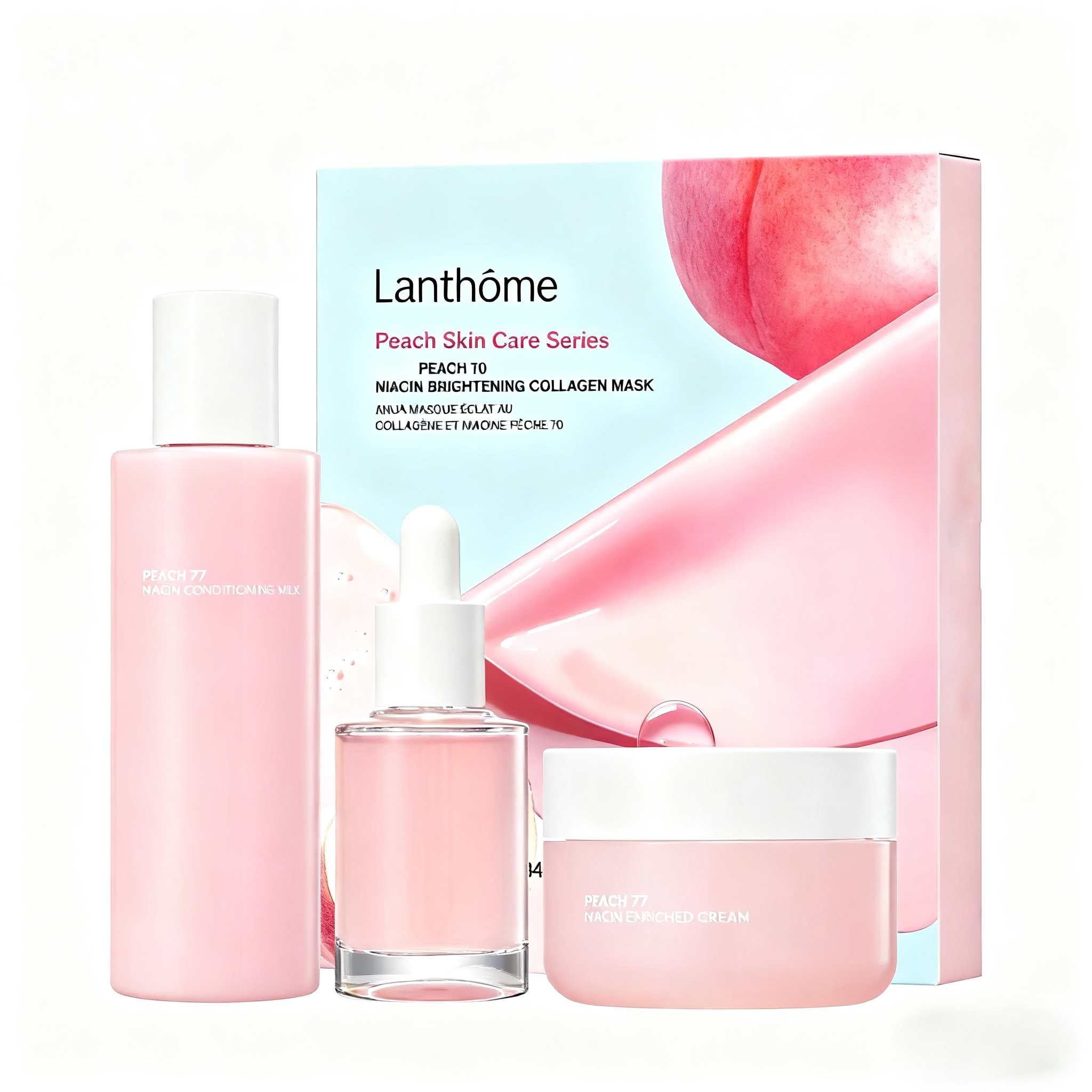
The catalog image shows pink containers and a rectangular pack. It is useful visual context, but it does not establish the complete included contents, their capacities or the packaging supplied with a future order. Label the photograph as the catalog reference in your request and describe the required configuration separately.
Give the request a revision name and date. When the brief changes, send that identifier with the new version. This simple habit makes it possible to tell whether two quotations answer the same request or different stages of the project.
Define the unit before comparing its price
Write one sentence stating what you want a quoted unit to represent. For example, a hypothetical request might define one unit as one finished set containing three specified products and one outer package. This sentence is an example structure; it does not describe the confirmed contents of the catalog set.
Separate a product piece from a finished set
Use different fields for the number of finished sets and the number of individual product pieces. If your proposed set contains three pieces, an order scenario of 400 sets contains 1,200 product pieces. That multiplication says nothing about the supplier's minimum order or how those pieces must be ordered.
Ask the supplier to state the unit beside every price and quantity. A price per bottle, a price per set and a price per shipping carton cannot be compared directly. Keep the original unit visible when you calculate a common basis for your own review.
Specify what makes the set complete
List the product, closure, label, individual carton if requested, outer presentation and assembly as separate scope items. Mark each as included, excluded or unanswered in each proposal. Avoid treating an empty quotation cell as either free or unavailable; obtain an explicit answer before calculating a completed-set comparison.
Match each component across the proposals
Create a component register before entering prices. For each proposed product, record the offered reference, fill amount, container reference and current description. Leave an unavailable field unanswered rather than carrying a value across from another supplier's offer.
The same category name is insufficient for a direct match. Two items called serum may have different proposed fills, packaging or specifications. Your comparison should show those differences plainly. The buyer can then decide whether to request matching options or evaluate them as distinct alternatives.
A concise register can include:
- Your internal component code and requested role in the set.
- The supplier's offered product and packaging references.
- The proposed fill amount and its unit, when supplied.
- The artwork or decoration included in the quotation.
- The response status and the question still needing an answer.
Keep a separate record for substitutions. If a supplier suggests a different jar or fill, preserve both the original request and the proposed change. Otherwise, a revised quotation may appear less expensive simply because it describes less product or a different presentation.
When a material difference remains, call the proposals alternatives instead of assigning them a single price ranking. You can still discuss them constructively, but the decision needs to acknowledge the different contents.
Separate recurring charges from project setup
Ask which amounts apply to every quoted unit and which apply once to the specified project scope. Keep the supplier's description of each charge alongside the number. This avoids silently spreading a project fee across a different quantity from the one used in the original offer.
Potential questions include whether artwork preparation, a proposed decoration setup, sample work or an assembly step has a separate charge. These are questions to clarify the commercial response, not statements that any particular service or fee exists for the Lanthome reference.
Record the basis of each charge
A setup amount may be described per artwork version, per component or per project. Those bases can produce different totals when a set has several products. Ask the supplier to identify the scope rather than relying on a short label such as “printing fee.”
Keep revisions separate from repeat orders
Do not assume an initial project charge disappears from every future order. Ask what would apply to an unchanged repeat and what changes could require a new quotation. Record the answer as part of that supplier's proposal, with its date and limitations, rather than converting it into a general rule for the category.
Use a transparent arithmetic comparison
The following example illustrates calculation only. It uses fictional amounts in the same unspecified currency and assumes that product specifications, packaging and included tasks have already been matched. It does not estimate market pricing or recommend a purchase quantity.
Imagine proposal A lists 400 finished sets at 12 currency units each, plus a project setup amount of 200. Under those assumptions, the listed total is 5,000: 400 multiplied by 12, then plus 200. Dividing that listed total by 400 gives 12.50 per set for the stated scope.
Proposal B lists the same hypothetical 400 finished sets at 11.80 each, plus a setup amount of 400. Its listed total is 5,120, or 12.80 per set under the same assumptions. The lower unit line does not produce the lower listed project total in this example.
Show exclusions beside the result
Neither calculation includes a cost that has not been provided. If freight, an outer package or another required item is excluded, mark the comparison incomplete for that item. Do not present the listed total as a complete delivered cost, and do not insert an unsupported allowance to make the columns look finished.
Keep quantities tied to their quoted terms
The arithmetic cannot establish what either supplier would charge for 800 sets. A different quantity requires an applicable quotation or an explicit pricing basis from the supplier. Use scenario calculations to understand the supplied numbers, while keeping unquoted quantities visibly separate from actual offers.
Clarify packaging and assembly responsibilities
A skincare set can involve product containers, labels, individual cartons, a set package and shipping packaging. List the requested layers and ask which party supplies each one. This makes a packaging exclusion visible before it becomes an assumption in the comparison total.
Ask whether the offer describes separate components or a completed set. If assembly is included, request a plain description of the included work. If it is excluded, identify who would arrange it and keep the related price field open until there is a response.
For buyer-supplied artwork or components, explain what you intend to provide and ask which inputs the supplier needs to evaluate that arrangement. Do not assume that the reference supplier accepts every proposed material, file or packing instruction. Record the offered process and any unresolved dependencies.
Use one pack contents record for the commercial comparison and the eventual sample discussion. A photograph of several products together should not override that record. When an image includes a display prop or a presentation concept, identify its role so that the quotation reader knows whether it belongs in the requested order.
Compare timing against the same starting point
Put every timing statement beside the event from which it is measured. “After artwork confirmation” and “after order confirmation” describe different starting points. Without that distinction, two durations may look comparable while answering different questions.
Ask for the sequence relevant to the offered project: information required, sample discussion, artwork completion, production readiness and dispatch. Use the supplier's actual response to fill the sequence. The catalog reference does not establish a lead time for a customized set.
Record which inputs your own team controls. If the brand still needs to decide the contents or provide artwork, show that dependency in the comparison. A purchasing colleague should be able to see why a date remains provisional without reading an entire email chain.
Distinguish a supplier's stated dispatch timing from arrival at your chosen destination. Request the scope of any delivery proposal and keep unsupplied information open. For this comparison, the important task is to capture what was actually offered, not to translate an incomplete timing statement into a promised launch date.
Make unanswered items visible in the review
Use a small set of response labels such as confirmed in proposal, offered alternative and awaiting answer. Apply them to individual items rather than marking an entire supplier green or red. One proposal may be clear about packaging but still lack a component specification.
Write each open question so that it can receive a concrete answer. “Please confirm whether the outer set package is included in the quoted unit” is more useful than “Please clarify packaging.” Reference the quotation line and the requested component code when available.
Keep unanswered amounts out of numerical rankings. A blank cell should remain blank with a reason. Treating it as zero would make an incomplete offer appear more competitive, while inventing a cost would obscure what the supplier has actually said.
Separate a necessary requirement from an optional preference. If an unresolved item is essential to the planned set, resolve it before calling the proposal comparable. If it is optional, compare the base scope and the optional scope separately. This gives the decision maker a choice that is easier to understand and reproduce.
Turn the comparison into a focused follow-up
Send each supplier a short list of questions tied to their own offer. Attach the current brief revision and identify the items that prevent comparison. Avoid asking them to interpret a mixed spreadsheet containing another supplier's names, private terms or unrelated notes.
For example, a follow-up could ask for the quoted unit definition, the offered references for three requested components and whether the outer package and assembly are included. The number of components in this example is a planning assumption, not a specification of the peach skincare set.
Request a consolidated revised proposal after the questions are answered. Save the earlier version for reference, but use one named current version for the next review. Piecing together a price from one message and packaging details from another can conceal a later change in scope.
When a response changes the offered configuration, update the component register before recalculating totals. Then check whether the other proposal still describes the same requested set. The comparison remains useful only while its columns refer to identifiable and sufficiently aligned offerings.
Prepare a decision note that preserves the reasoning
Finish the comparison with a short note explaining which proposal is ready for the next discussion and why. Name the exact quotation revision, the requested set configuration and the unresolved items. The note should describe the evidence behind the choice without suggesting that a spreadsheet score guarantees product performance or a successful launch.
Separate the reasons into scope, cost information and practical dependencies. Scope describes how closely the offered contents match the brief. Cost information describes which amounts have been supplied and what they cover. Dependencies describe the answers or buyer inputs still needed before the project can advance. This structure prevents one attractive number from hiding a difference elsewhere.
If the team chooses to discuss a more expensive listed proposal, record the concrete reason. Perhaps it describes the requested outer package while another offer leaves that item unanswered. That does not prove the other supplier cannot provide the package; it explains why the currently available information supports a particular next step.
Keep the decision at the right stage. Selecting a proposal for further discussion is different from accepting an order. State the next action plainly, such as requesting a revised contents list or asking for a sample proposal based on the matched configuration. Assign that action to a named project role and record the answer when it arrives.
Before sharing the note internally, ask a colleague to reproduce the illustrative calculation from the quoted lines. They should also be able to identify every exclusion without your explanation. If the total or scope requires verbal clarification, improve the record before using it as the basis for a purchasing conversation.
Common questions about skincare set quotations
Is the lowest listed unit price the best comparison?
It is one input. Compare the defined unit, included components and listed project charges together. A lower unit line may describe a different fill, an excluded package or a different setup basis. Make those differences visible before deciding which proposal to advance.
Can the catalog photograph define the final set?
Use it to identify the visual reference, then ask for an explicit contents list. For the Lanthome peach set reference, the image and title do not provide a complete component specification. An agreed written description gives the supplier and buyer a clearer basis for discussion.
What should the first inquiry include?
Include the reference URL, your intended set contents, quantity scenario, packaging request and the details you need to compare. Submit those questions through the Lanthome project inquiry page. Request a response that identifies the offered configuration, price units, included work and remaining decisions so that your team can assess the proposal on a consistent basis.
Related Links
- Lanthome Peach Skincare Set Reference - View the set reference identified by SKU 1601582740388.
- Skincare Products - Browse the site's available product references.
- OEM and ODM Development - Explore development information for a project brief.
- About Lanthome - Read the company introduction and project focus.
- Project Inquiry - Request details about the configuration your brand is considering.
- Buyer Insights - Read additional planning articles for skincare buyers.
- Soap Gift Assortment Guide - Explore a separate guide to defining gift combinations and their contents.